If you are like most high-level professionals, you probably tolerate your website, but you don't love it.
It's there. It has your phone number. It lists your degrees or past projects. It verifies that you exist. But deep down, you know the uncomfortable truth: it is not winning you business.
For years, the standard advice for consultants, lawyers, architects and speakers was simple: "just get something online." So you treated your website like a digital checkbox. You hired a designer or bought a template, approved a clean layout, wrote a generic about page, and went back to work.
But while you were working, the way your clients buy changed.
The referral paradox and the silent leak
"I don't need a great website," you might say. "My business runs on word-of-mouth."
This is the most dangerous myth in professional services, and it leads to the referral paradox. You meet a prospective client and make a great impression. They walk away intending to hire you, but first they do what everyone does: they Google you. This is where the silent leak happens.
Doubt creeps in: "maybe they aren't as cutting-edge as they sounded." A brochure site merely validates your existence; an Authority Platform validates your expertise during the part of the buyer journey that now happens before the first contact. If they find a generic, thin website, AI search tools summarise your services into a commodity list and bypass your unique value entirely. Meanwhile a competitor with deep, citable insight gets named as the definitive source. Kind of like this:
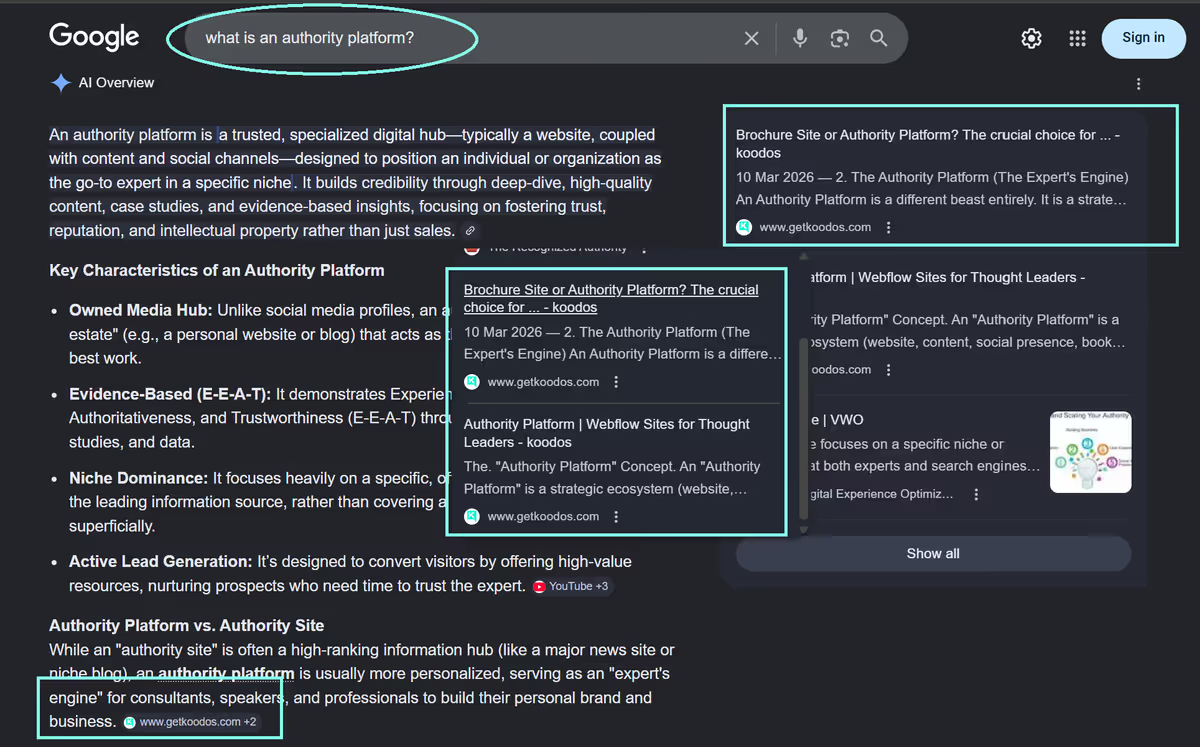
1. The brochure site (the corporate standard)
Let's be clear: there is nothing inherently wrong with a brochure site.
For a small-to-medium enterprise, a manufacturing firm or a local service company, a well-designed brochure site is often exactly what's needed. It acts as a digital signpost: validating the company's existence, showcasing catalogues, providing contact details. When the brand is the company, this model works perfectly well.
The trap closes when high-value individuals, consultants, speakers, attorneys, architects, adopt this corporate model. Because web design isn't your core focus, it is easy to rely on standard templates and corporate-style layouts. You end up with a site that looks professional but sterile, and it can cost you:
- It hides you. It focuses on services rather than perspective.
- It blends in. With a standard template you look identical to a novice who bought the same theme for £50.
- It is passive. It waits for traffic rather than driving conversation.
When you are the product, a brochure site acts like a mask. It strips away the very thing that lets you charge premium fees: your authority.
2. The Authority Platform (the expert's engine)
An Authority Platform is a different beast entirely: a strategic digital engine for individuals whose business relies on trust, reputation and intellectual property.
- Evidence-based. It moves past "what we do" to proof: deep-dive case studies, data-backed results, specific outcomes.
- Active. It captures leads through high-value resources, distributes your thinking, and nurtures prospects who aren't ready to buy yet.
- Owned media. It archives your best thinking on real estate you own, unlike LinkedIn or X, where the platform owns the audience.
- Structured for trust. Schema markup and E-E-A-T signals prove credibility to human readers and AI search engines alike.
The owner of an Authority Platform treats their site as critical infrastructure: the salesperson who never sleeps, never asks for a raise, and never has a bad day.
The comparison at a glance
                  brochure site               authority platform
primary goal      inform, validate existence  validate expertise, convert trust
content focus     service lists, history      case studies, insight, ip
social proof      standard testimonials       integrated results and media
differentiation   branding and logo           unique perspective and voice
investment        one-time "get it done"      ongoing investment in an asset
Why this matters now
You might be thinking: "my current site is clean and professional. Isn't that enough?"
- Buying behaviour has shifted. B2B buyers complete most of their purchasing journey before they ever contact a supplier. If your site doesn't answer their deep questions, you are eliminated before the first meeting.
- The template trap. The barrier to looking professional has collapsed. A 22-year-old novice with a Squarespace template looks as polished as a 20-year veteran with a brochure site. Depth of experience needs somewhere to show.
- The cost of invisibility. Authority dictates premium pricing; a generic site commands generic fees. Look like a commodity and you will be negotiated down like one.

The paradigm shift
Moving from a brochure site to an Authority Platform is a mindset shift, from decorating to engineering. Your reputation is your most valuable asset, built over decades. Why is your website, the primary window through which the world views that reputation, the weakest link in your business?
Stop accepting the status quo. Contact me →